← Back to the Herbarium
Floral
Martagon lily
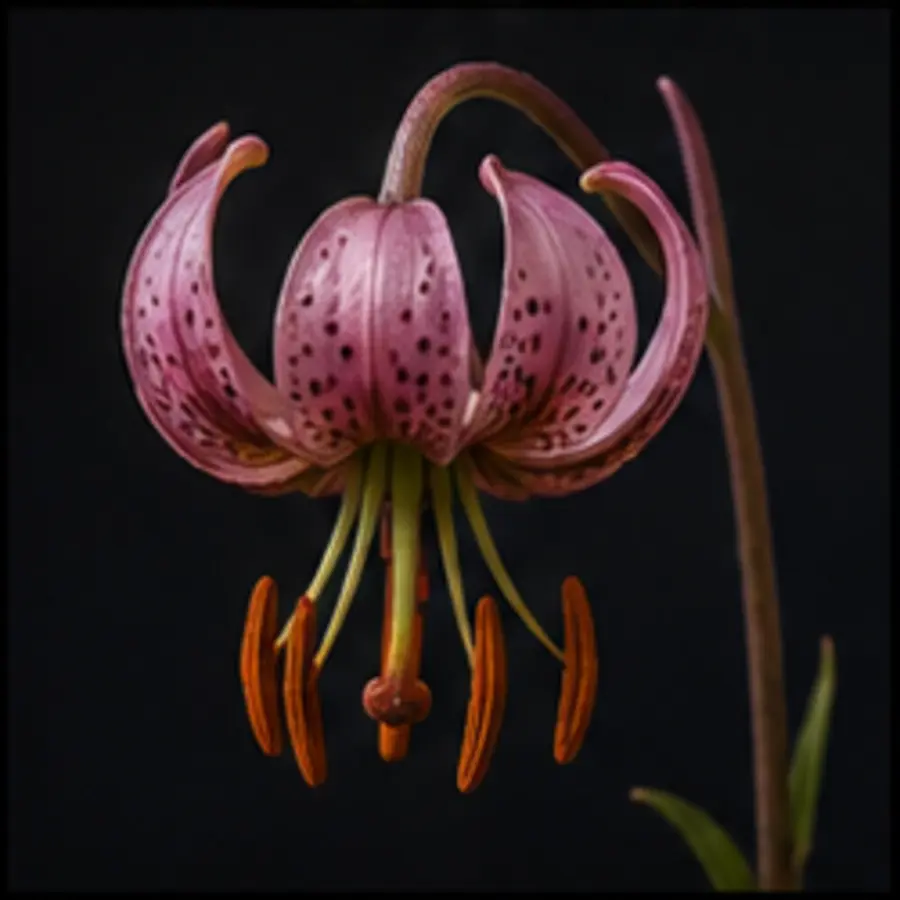
Lilium martagonHanging flowers with recurved, purple-spotted segments give martagon lily its distinctive silhouette. It belongs to open woodland and mountain meadows.
Floral
France · Austria · Switzerland · Italy · Slovenia
Lilium martagonLilium martagon is a member of the lily family with a scaly bulb. Some leaves form whorls around the stem. Each nodding flower has six recurved tepals and six stamens; tepals are floral segments not clearly differentiated into sepals and petals. In Switzerland the plant occurs particularly in deciduous woodland, meadows and tall-herb vegetation, often on limestone soils.
The Swiss reference flowering period is June and July. Three-chambered capsules develop afterwards, containing numerous seeds. The bulb allows the plant to persist from one season to the next. These stages describe its botanical cycle, rather than a customary fragrance harvest from the bulbs.
Periods vary with region, altitude and yearly conditions.
Lily evocations in perfumery are usually composed as floral accords. The character of the flowers, their spicy nuances and the woodland atmosphere guide the construction.
A lily-inspired accord can be full and floral, with a spicy dimension. Green nuances and a discreet base give it the freshness of mountain woodland.
Recurved tepals expose the stamens and turn each flower into a small hanging structure. That outline, as much as the spotted colour, distinguishes martagon from the more open image of many garden lilies.