← Back to the Herbarium
Sandalwood
Santalum albumWhite sandalwood, Santalum album, offers a milky, velvety wood whose softness unfolds slowly. Its aromatic richness develops within the heartwood.
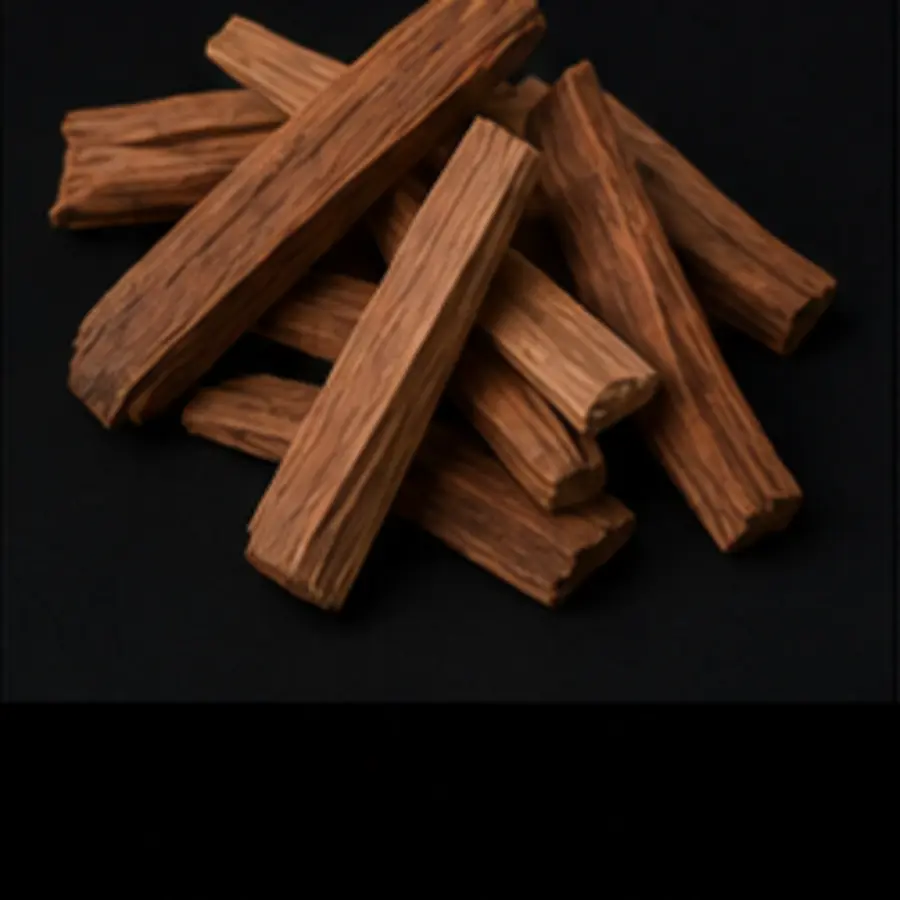
India · Australia
Santalum albumIndia is its historic reference territory; plantations of the same species also exist around Kununurra in Western Australia. This hemiparasitic tree connects its roots to host plants to supplement its water and nutrient supply.
Harvest is governed by years of growth and heartwood formation more than by calendar month. One Australian plantation system designed for Santalum album reports harvesting at around fifteen to sixteen years; this benchmark does not apply to every tree or site. Rich heartwood and root sections are selected.
The wood is chipped and then milled before prolonged distillation. Santalols carry much of the sought-after signature. The less aromatic outer wood does not yield like the heartwood; mixing these fractions changes both extraction economics and the resulting profile.
An Indian forestry institute reports 3–6% oil in Santalum album heartwood.
Sandalwood rounds white flowers, gives continuity to musks and supports orris with a creamy texture. Its effect suggests a polished, warm surface, with gentle persistence rather than a sharply resinous opening.
Perfumery uses several Santalum species. Australian Santalum spicatum and New Caledonian Santalum austrocaledonicum have their own characteristics; a country name therefore cannot replace botanical identification.