Maison du Lac Évian-les-Bains
Cart
EN
FrançaisEnglishEspañolDeutschItalianoNederlandsالعربية简体中文Polski日本語Português (Portugal)한국어SvenskaБългарскиΕλληνικάDansk
Menu
← Back to the Herbarium

Aromatic

Alpine yarrow

Achillea millefolium
A leaf cut like a feather, white bouquets and a scent of dry herbs: yarrow creates an aromatic meadow material. Its alpine interpretation keeps the light and simplicity of these flowery expanses.
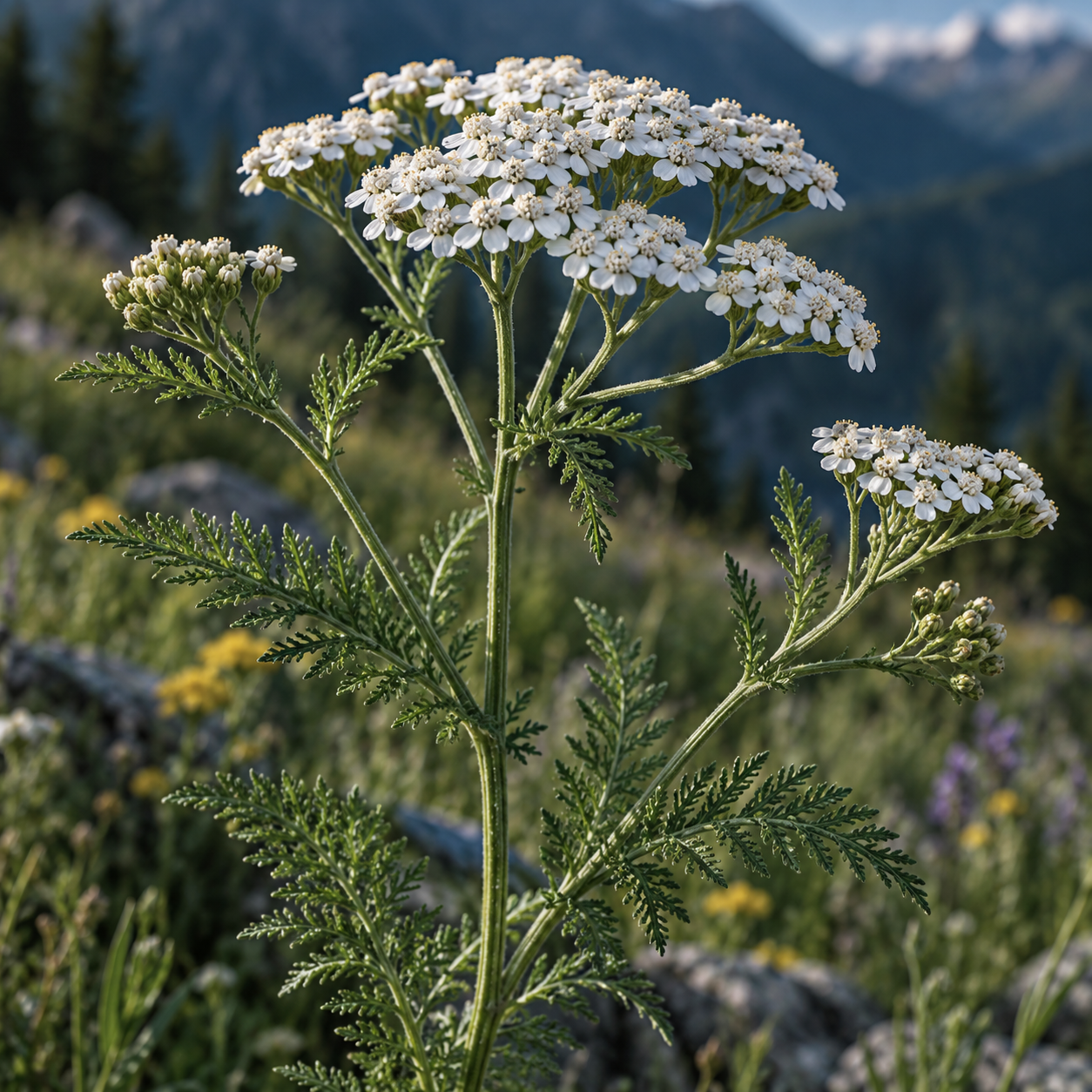
Alpine yarrow
01 · Natural material

Origins & territories

France · Austria · Switzerland · Italy · Slovenia

Achillea millefolium

Achillea millefolium belongs to the Asteraceae and grows in meadows, pastures and along paths, including at mountain elevations. Its deeply divided leaves accompany flat clusters of small white or sometimes pinkish flower heads. The alpine evocation in this profile forms part of a wider botanical range.

FranceAustriaSwitzerlandItalySlovenia
Alps · indicative area
02

Flowering & plant cycle

Flowering generally extends from June to September in the Swiss region. The flowering aerial parts are cut for the aromatic sectors, then prepared according to the desired product. The small flower heads and leaves together contribute to the plant character.

Flowering · botanical reference · Switzerland

  1. Jan
  2. Feb
  3. Mar
  4. Apr
  5. May
  6. Jun · Indicative period
  7. Jul · Indicative period
  8. Aug · Indicative period
  9. Sep · Indicative period
  10. Oct
  11. Nov
  12. Dec

Periods vary with region, altitude and yearly conditions.

03

From material to extract

Steam distillation of the flowering aerial parts provides an essential oil. The steam carries away the volatile constituents, then condensation separates the oil from the water. Herbal extracts prepared in other solvents constitute another family of products.

04

In a composition

Oil from the flowering tops can enrich herbaceous, aromatic or woody accords. Its colour and profile vary with the raw material and distillation; some batches have a bluish tint associated with azulenes formed during the process.

05

History & uses

The name millefeuille alludes to the numerous divisions of the leaves. The appearance of a single large white head actually comes from a multitude of small flower heads gathered together: this architecture links yarrow to other Asteraceae, despite its silhouette being very different from a daisy.