← Back to the Herbarium
Hiba wood
Thujopsis dolabrataHiba sketches a darker, denser forest: pronounced wood and resin, with an aromatic freshness recalling shavings and a joiner’s workshop.
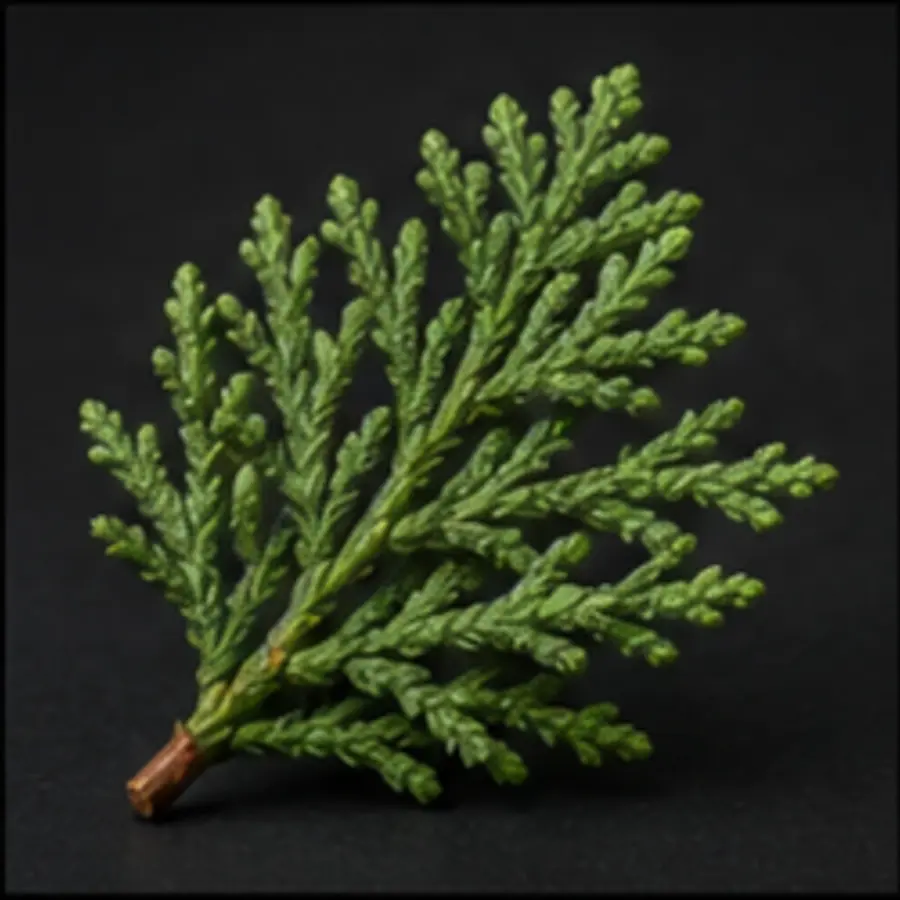
Japan
Thujopsis dolabrataThujopsis dolabrata is a Japanese conifer in the Cupressaceae family. Aomori, in northern Honshū, is a characteristic origin for its essential oil. Hiba and hinoki are different trees despite their similar names.
Prepared wood, including sawmill residues, provides the extraction material. Using offcuts and sawdust captures an aromatic fraction of timber already being worked. Particle size affects how the charge behaves during extraction.
Steam distillation produces a wood essential oil, separated from water after condensation. Research on Aomori residues shows that extraction time and sawdust preparation can change the composition of the recovered oil.
Hiba can provide a woody foundation and a resinous accent in forest compositions. Its assertive character may deepen a conifer accord or an impression of damp timber. A small touch can make the imagined landscape feel denser.
The oil contains constituents such as thujopsene and cedrol and is also studied for hinokitiol. A molecule’s name alone does not identify the tree behind a bottle: botanical identity and the distilled part remain better guides.