← Back to the Herbarium
Juniper
Juniperus communis subsp. communisBetween spicy berry and conifer freshness, juniper brings a dry, lively, resinous character. Its berry essential oil has a different identity from needle or wood extracts.
France · Bulgaria · Croatia · Serbia
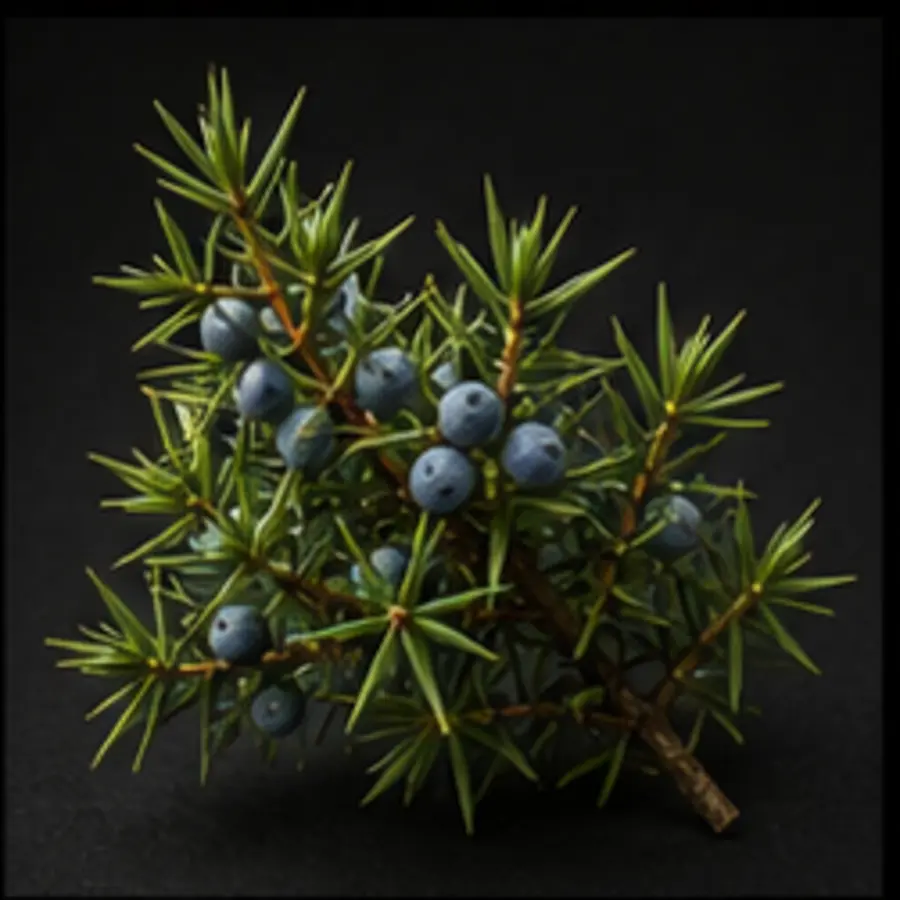
Juniperus communis subsp. communisJuniperus communis is a conifer in the Cupressaceae family. In Europe it grows in heathland, open woodland and on dry slopes. Its evergreen needles are sharp; the small blue-black structures called berries are fleshy cones. The Balkans supply the fragrance industry, with production chains in Serbia and Bulgaria. Its presence in the Alps describes a habitat, rather than necessarily the origin of a commercial oil.
In Switzerland, flowering generally occurs in April and May. Berries ripen on a different schedule: one Balkan supply chain harvests them from September to November. Green and ripe cones may coexist on a branch. Collection selects mature berries, which are then sorted before processing.
Periods vary with region, altitude and yearly conditions.
Distilling the berries with water or steam carries over their volatile constituents. After condensation, the essential oil is separated from the water. Some grades are then rectified through a further separation to adjust their scent profile. Berry oil, needle oil and wood extract are different materials.
One rectified Balkan grade reports approximately 70 kg of plant material per 1 kg of oil.
The opening is fresh, aromatic and gently spicy, sometimes recalling gin. Green top notes develop into woody, resinous nuances. With citrus, juniper reinforces dry freshness; with woods, it extends the impression of a conifer landscape. These are possible uses in composition, without implying a particular Maison du Lac formula.
Juniper berries also belong to European culinary traditions and are used to flavour gin. This association helps explain their spicy, resinous scent. Whole spice, a flavoured drink and a perfumery essential oil nevertheless remain distinct preparations.