← Back to the Herbarium
Nutmeg
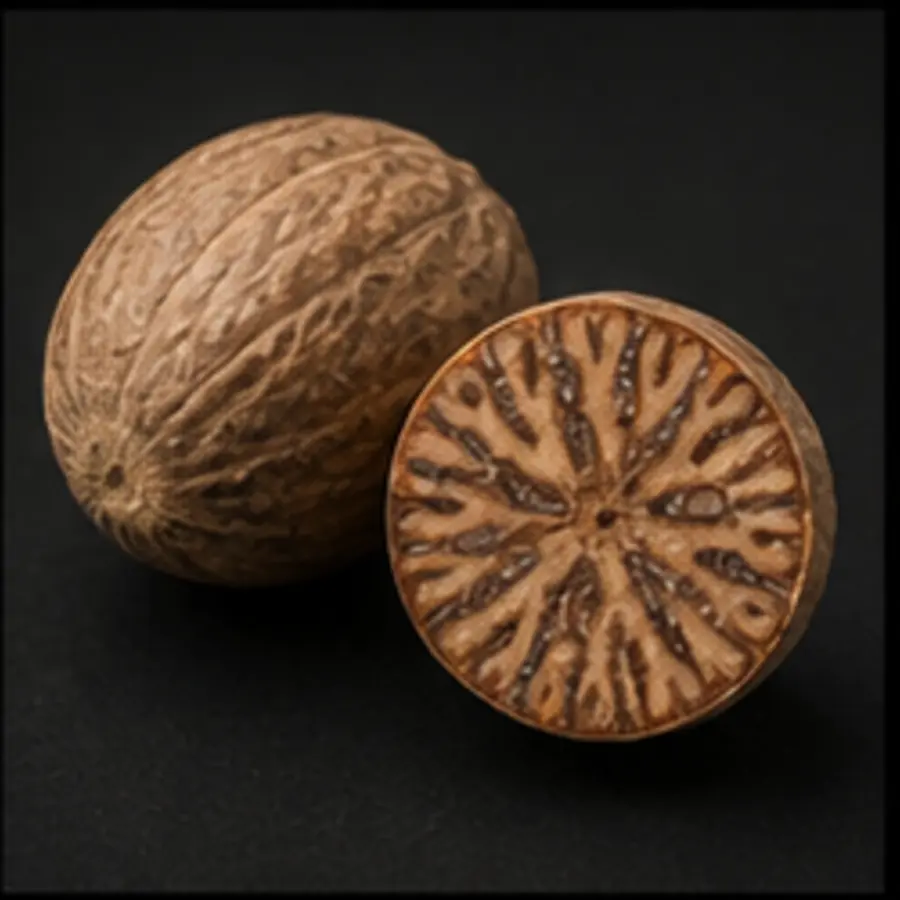
Myristica fragransNutmeg brings aromatic warmth crossed by bright freshness. Its oil gives a woody spice, less dark than grated nutmeg may suggest.
Indonesia · Sri Lanka
Myristica fragransMyristica fragrans is a tropical Myristicaceae tree. Indonesia’s Banda Islands are its historic territory; Sri Lanka also produces a documented perfumery oil. A single fruit provides the seed called nutmeg and a lacy covering known as mace.
The ripe fruit splits to reveal the seed surrounded by its aril. After collection, mace is separated and seeds are dried before preparation. One Sri Lankan grade lists March–May and September–October; the Indonesian calendar may differ.
Periods vary with region, altitude and yearly conditions.
Prepared nutmeg is hydrodistilled to obtain essential oil. Sabinene and pinenes contribute its aromatic opening. This volatile oil differs from nutmeg butter, a fatty fraction obtained through other operations, and from mace oil.
One organic Sri Lankan oil reports approximately 20 kg of nutmeg per kilogram of essential oil: 2 kg for 100 g.
Nutmeg connects citrus freshness to a spicy heart and woods. It can give sandalwood grain or vanilla a drier warmth. Its aromatic vibration keeps an amber accord moving without making it solely sweet.
Nutmeg and mace are two materials from one fruit. The “nut” is not the whole fruit, which explains why yields, profiles and commercial values must be compared on the same basis.