← Back to the Herbarium
Floral
Neroli
Citrus aurantiumNeroli is the essential oil of bitter-orange blossoms. It combines the luminosity of orange flower with green freshness, quite distinct from the expressed oil of the peel.
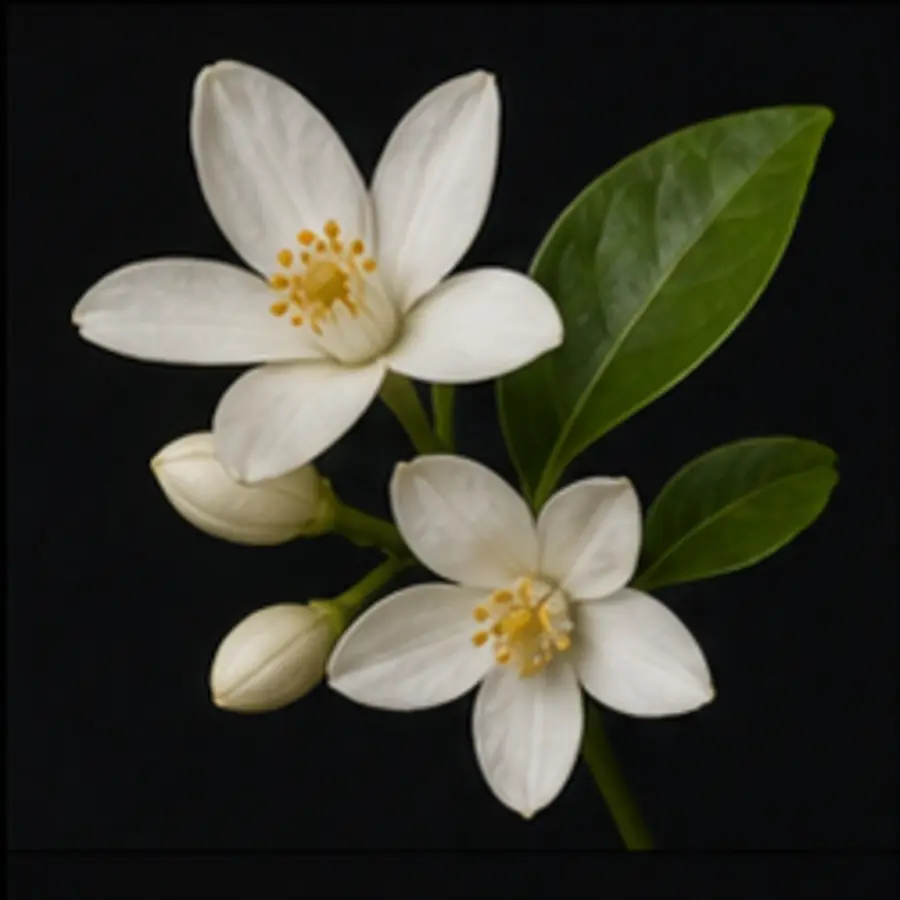
Floral
Tunisia · Morocco · Egypt
Citrus aurantiumCitrus aurantium, bitter orange, belongs to the Rutaceae family. Tunisia, Morocco and Egypt are reference origins for its fragrant production. One tree can provide several materials: neroli from blossoms, petitgrain from leaves and twigs, and bitter-orange oil from fruit peel. These names therefore identify different plant parts and processing methods.
Open flowers are hand-picked in spring and taken quickly to the distillery. One reference Egyptian grade lists March and April; other regions may have campaigns extending into May. The season depends on the production area and year: a peel or petitgrain calendar cannot replace the flower calendar.
Periods vary with region, altitude and yearly conditions.
The flowers are distilled with water or steam. After condensation, neroli essential oil is separated from the floral water. Solvent extraction of the blossoms, followed by alcohol purification, produces another material: orange-blossom absolute, generally denser and more enveloping. One is not merely a more concentrated version of the other.
One Egyptian neroli oil reports about 1,000 kg of flowers per 1 kg of oil.
Neroli brings a fresh white floral impression with green and delicately orange-like nuances. It combines naturally with bergamot and petitgrain in the Cologne tradition. In a floral bouquet it can introduce air and green tension rather than creamy volume. Its luminosity should not be confused with a simple orange-juice smell.
Orange-blossom water and neroli oil share a processing stage but remain different products. Odorant molecules partition differently between water and oil: floral water is therefore not simply diluted essential oil.