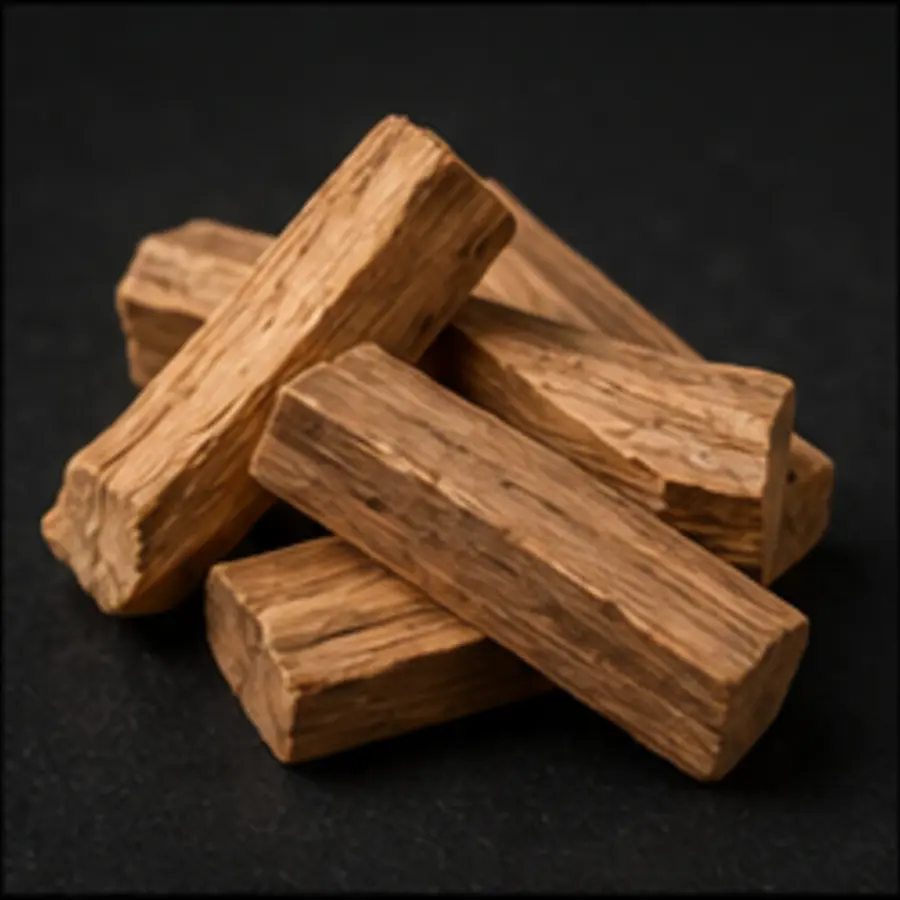
Australian sandalwood
Santalum spicatum (Fusanus spicatus)

Australia
Santalum spicatum (Fusanus spicatus)The material presented here is Santalum spicatum, also listed as Fusanus spicatus, associated with Western Australia. Other sandalwoods, including cultivated Santalum album, are produced in Australia too. Country of origin alone does not identify the species.
The documented spicatum grade uses wood and roots, prepared for the still. Its supply and production calendar extends through the year; this does not mean the tree flowers continuously.
Periods vary with region, altitude and yearly conditions.
Hydrodistillation releases the aromatic constituents from the woody material. They travel with the steam and separate from water after cooling. Species and grade then determine the texture available to the perfumer.
For the spicatum grade described by LMR, about 50 kg of plant material produces 1 kg of essential oil, roughly 2% by mass. This reference applies to that grade and its processed parts.
Spicatum can support a skin accord, a bouquet or an ambery structure. Herbal and spicy touches keep movement within a creamy base, while leathery nuances add a darker depth as the top notes fade.
Two bottles marked Australia can therefore tell different sandalwood stories. Knowing the species helps explain why one seems milkier and another drier or spicier before comparing their use in a composition.