← Back to the Herbarium
Aromatic
Clary sage
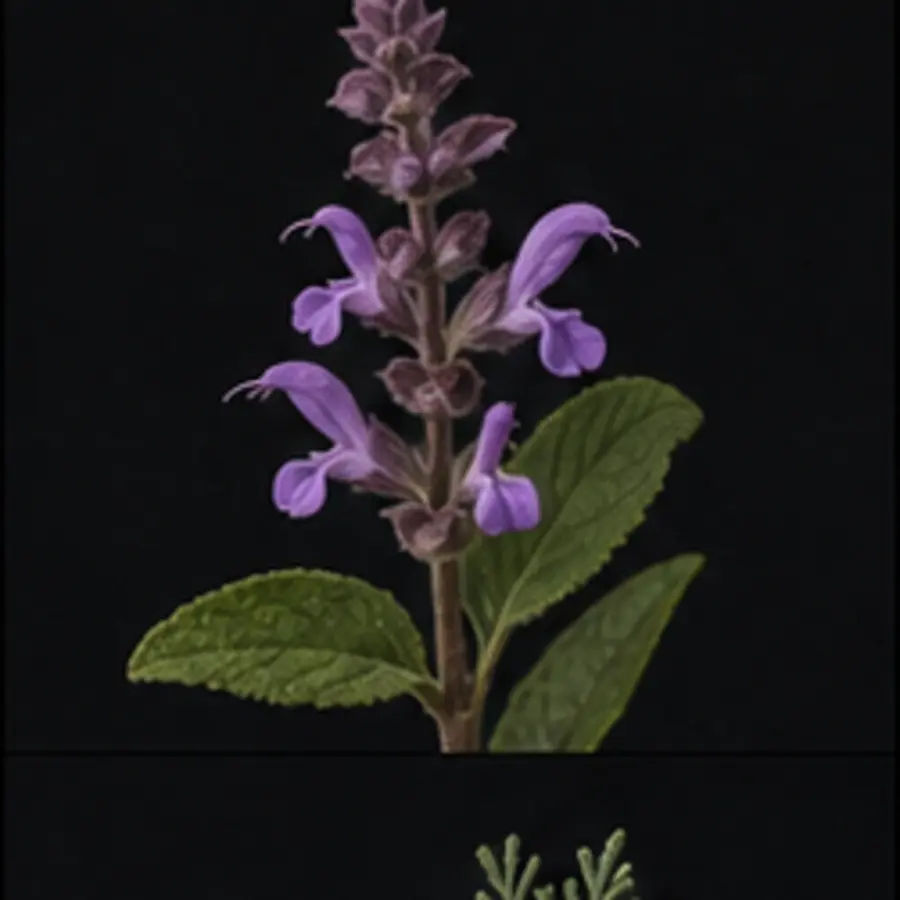
Salvia sclareaClary sage brings aromatic warmth with lavender, tea and hay facets. Its base may suggest ambery softness while retaining a vegetal presence.
Aromatic
France
Salvia sclareaSalvia sclarea is a Lamiaceae species distinct from common sage. France supplies documented perfumery oils. Its large inflorescences and aromatic parts form the harvest material, rather than simply culinary leaves.
Stems and flowers are cut during the summer campaign. One French grade lists July. Developmental stage and cutting conditions influence the profile of the material delivered to the still.
Periods vary with region, altitude and yearly conditions.
Hydrodistillation produces essential oil rich notably in linalool and linalyl acetate. Other plant-processing routes work with sclareol, used in manufacturing chains for ambery materials. Essential oil, absolute and an isolated constituent remain different objects.
One documented French oil requires approximately 400 kg of stems and flowers per kilogram of oil, or 40 kg for 100 g.
Clary sage extends lavender within a fougère accord and gives woods herbal warmth. Tea and hay nuances naturally connect fresh notes to tonka or musks. It can soften structure without making it uniformly sweet.
Its palette value includes this dual life: a fragrant material in its own right and a plant associated with other industrial transformations. An ambery facet perceived in oil does not make it equivalent to an isolated amber molecule.